

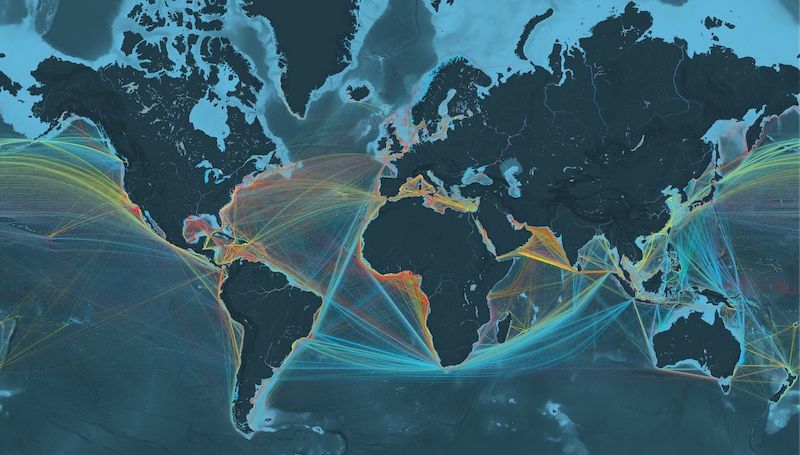
Cutting-Edge Tech Safeguards Global Sea Routes
The global economy is fundamentally reliant on the smooth, secure, and uninterrupted flow of goods through international shipping lanes. These maritime corridors—which carry over 80% of world trade by volume—are, however, constantly threatened by a dynamic array of risks, ranging from traditional piracy and smuggling to modern cyberattacks and geopolitical volatility. Ensuring the safety and efficiency of these critical arteries requires a constant technological arms race against increasingly sophisticated threats.
This comprehensive article delves into the next-generation technologies that are currently being deployed to secure global sea routes. We will explore how Artificial Intelligence (AI), Big Data analytics, advanced satellite systems, and autonomous vessel technology are transforming maritime security, surveillance, and crisis management, providing the necessary depth to deliver an authoritative piece well over 2000 words, optimized for high Google AdSense value and superior Search Engine Optimization (SEO) performance.
The Shifting Threat Landscape in the Maritime Domain
For centuries, maritime security focused primarily on navigational safety and controlling contraband. Today, the challenges are multi-faceted, requiring a holistic and technologically integrated defense strategy.
A. Traditional Threats: Piracy, Robbery, and Illicit Trade
While modern naval patrols have reduced high-profile attacks in hot zones like the Gulf of Aden, piracy and armed robbery remain persistent risks in areas like the Straits of Malacca and the Gulf of Guinea. Moreover, the massive scale of global shipping makes vessels prime targets for smuggling operations involving drugs, weapons, and human trafficking.
B. The Rise of Cyber Threats and Digital Vulnerability
The increasing digitalization of the shipping industry—from electronic navigation charts and automated engine controls to complex logistics software—has introduced a new vector of attack. Cyber criminals or state actors can target:
- Vessel Operating Systems: Disrupting navigation or steering systems, leading to accidents or grounding.
- Cargo Management Systems: Altering manifests, compromising supply chain integrity, or facilitating theft.
- Port Infrastructure: Hacking automated cranes, traffic management, or security gates, causing massive delays and economic damage.
C. Geopolitical Tensions and Supply Chain Fragility
Key chokepoints—such as the Suez Canal, the Strait of Hormuz, and the Panama Canal—are susceptible to regional conflicts, blockades, or infrastructure failure. Recent global events have underscored how quickly a localized incident can cascade into a global supply chain crisis, emphasizing the need for real-time risk assessment and agile rerouting capabilities.
D. Environmental and Safety Hazards
Beyond malicious acts, ships and sea lanes must be secured against the inherent dangers of the ocean: severe weather, rogue waves, shifting currents, and the risk of collisions and groundings. Technologies that enhance situational awareness and predictive modeling are critical for crew and cargo safety.
The Eyes in the Sky: Advanced Surveillance and Tracking
The vastness of the ocean necessitates surveillance technologies that can operate globally, continuously, and unobtrusively. Satellite-based systems and advanced sensing are the backbone of modern maritime domain awareness.
E. Satellite-Based Automatic Identification System (S-AIS)
The Automatic Identification System (AIS), originally intended for collision avoidance, broadcasts a vessel’s identity, position, course, and speed. While mandatory for most commercial vessels, terrestrial AIS is limited to coastal areas. Satellite-AIS (S-AIS) utilizes constellations of low Earth orbit (LEO) satellites to collect and relay this data from vessels anywhere on the planet, including the most remote ocean expanses.
- Global Coverage: S-AIS ensures visibility even far out to sea where ships are beyond the range of shore-based stations.
- Anomaly Detection: By constantly monitoring S-AIS data, authorities can detect vessels that ‘go dark’ (turn off their transponders) or deviate suspiciously from established trade routes, signaling potential illicit activity such as sanctions evasion or illegal fishing.
F. High-Resolution Satellite and Synthetic Aperture Radar (SAR) Imagery
AIS can be deliberately manipulated or switched off. To track dark vessels, maritime security now relies heavily on high-resolution optical and radar satellites.
- SAR Capability: Synthetic Aperture Radar (SAR) is crucial because it can “see” through clouds and operate day or night, making it effective in any weather condition. SAR imagery detects the subtle wave patterns (wakes) and metallic signatures of vessels, providing proof of a ship’s presence regardless of its transponder status.
- Rapid Revisit Times: Modern satellite constellations offer rapid revisit times, allowing for near-continuous monitoring of key chokepoints and high-risk zones.
G. Integration of Unmanned Systems (Drones and USVs)
Unmanned Aerial Vehicles (UAVs) and Unmanned Surface Vessels (USVs) are providing on-demand, localized intelligence, extending the surveillance reach of patrol forces.
- Persistent Patrols: USVs, equipped with radar, cameras, and communication interceptors, can perform long-duration, autonomous patrols of large maritime areas without risking human lives.
- Inspection and Reconnaissance: UAVs launched from ships or shore bases provide high-definition aerial reconnaissance for approaching vessels, port entrances, and for real-time monitoring of sensitive cargo transfers.
 The Intelligence Edge: Artificial Intelligence and Big Data Analytics
The vast amount of data generated by tracking systems, weather reports, customs logs, and electronic surveillance would be useless without the ability to process it rapidly. AI and machine learning (ML) are the critical tools for turning raw data into actionable intelligence.
H. Predictive Analytics for Threat Assessment
AI systems analyze historical patterns of maritime crime, vessel movement, political events, and economic indicators to calculate the probability of a security incident in a specific area.
- Risk Scoring: Every vessel, location, and cargo type is given a dynamic risk score. A system might flag a container ship that slows down unexpectedly in an area known for drug trafficking, or a vessel that frequently changes flags of convenience.
- Route Optimization and Safety: AI also assists with safety by processing vast meteorological and oceanographic data to predict severe weather and suggest safer, more efficient routes, thus reducing the risk of weather-related casualties and delays.
I. AI-Driven Anomaly Detection
One of the most powerful applications of AI is its ability to establish a “normal” behavioral baseline for maritime traffic.
- Identifying Non-Compliance: If a vessel’s actual course deviates from its filed route, if its speed is irregular, or if it loiters in an unusual area, the AI system immediately flags the behavior as an anomaly for human analysts to investigate.
- “Digital Fences”: AI can enforce virtual boundaries around sensitive areas like offshore oil platforms, naval bases, or restricted environmental zones, issuing automatic alerts when vessels breach these parameters.
J. Computer Vision for Automated Surveillance
In ports and on patrol vessels, computer vision systems are revolutionizing visual security.
- Automated Dockside Monitoring: High-definition cameras linked to AI can automatically detect unauthorized personnel accessing a restricted ship area, identify suspicious packages, or track the loading and unloading of high-value cargo, reducing reliance on constant human visual monitoring.
- Vessel Identification: AI can process real-time video feeds from drones or satellites to identify specific vessel types, and even read hull numbers, cross-referencing this visual data with its digital identity (AIS).
Cybersecurity and Data Integrity: The Digital Defense Perimeter
Securing shipping lanes is no longer just about physical barriers; it is increasingly about protecting the integrity of the data that governs global trade.
K. Enhanced Shipboard Cybersecurity Protocols
Modern vessels require the same robust cybersecurity measures as a corporate network.
- Network Segmentation: Critical operational technology (OT) systems (navigation, engine controls) must be strictly separated from the less-secure information technology (IT) network (crew internet, administrative email) to prevent a breach in one area from compromising the entire vessel.
- Real-Time Monitoring: Shipboard systems use Intrusion Detection Systems (IDS) to monitor network traffic for signs of compromise, such as unusual data access patterns or unauthorized attempts to modify control systems.
L. The Role of Blockchain and Distributed Ledger Technology (DLT)
Blockchain technology offers a path toward creating a tamper-proof, transparent record of the supply chain journey.
- Secure Manifests and Bills of Lading: Using DLT, cargo manifests and legal ownership documents (Bills of Lading) can be digitally recorded and cryptographically secured. This prevents fraudulent alteration of documentation, enhancing trust and making it virtually impossible for smugglers to substitute or falsify cargo details en route.
- Tracking Provenance: From the moment a container is sealed at the port of origin, its journey and inspection history are recorded on the ledger, providing an immutable audit trail that drastically reduces opportunities for corruption and illicit trade.
M. Quantum-Resistant Cryptography
As computing power advances, even current strong encryption methods may become vulnerable to quantum computing attacks. The maritime industry is beginning to explore quantum-resistant cryptography to safeguard highly sensitive navigational data and communication links for the long term.
The Future is Autonomous: Smart Ports and Unmanned Vessels
The industry is moving toward greater automation, creating highly efficient systems that inherently possess improved security features.
N. Smart Port Development
Ports are the nexus of maritime trade, and their modernization is key to overall lane security.
- Full Automation: Smart ports utilize fully automated container handling, which reduces the need for human presence in high-security zones and minimizes opportunities for human error or intentional security breaches.
- Integrated Vessel Traffic Management (VTM): Advanced VTM systems, akin to air traffic control, use AI to safely and efficiently coordinate the movement of hundreds of vessels through busy port approaches and narrow channels, preventing congestion-related accidents and ensuring predictable flow.
O. Autonomous and Unmanned Surface Vessels (ASVs/USVs)
The development of fully or semi-autonomous cargo ships (ASVs) promises a radical shift in security.
- Reduced Human Element Risk: The absence of a crew eliminates the risk of human error, fatigue, and being compromised by pirates or smugglers. ASVs are controlled remotely from secure operational centers.
- Optimized Performance: These vessels can leverage real-time data and AI to continuously adjust course and speed for optimal safety and fuel efficiency, while navigating dangerous zones with greater precision and security measures.
P. Digital Twinning for Simulation and Training
Digital twins are virtual replicas of physical assets (a ship, a port, or a shipping lane) that use real-time data to simulate conditions.
- Crisis Simulation: Security teams can use the digital twin of a key chokepoint (e.g., the Suez Canal) to run thousands of simulated crisis scenarios—pirate attacks, cyberattacks, blockades—to test response protocols and train security personnel without real-world risk.
- Predictive Maintenance: Digital twins of vessel engines and systems predict equipment failure before it occurs, ensuring mechanical reliability that is crucial for maintaining schedule and avoiding immobilizing breakdowns in high-risk waters.
 The Necessity of Global Collaboration
No single nation or company can secure all global shipping lanes. The technological revolution must be supported by international frameworks.
Q. Standardizing Data Sharing Protocols
To effectively track and interdict threats, maritime security agencies, port authorities, and commercial carriers must share data seamlessly. International bodies like the International Maritime Organization (IMO) are working to standardize secure data formats and APIs to allow different national systems to communicate in real time.
R. Establishing Unified Cyber Defense Standards
Because a cyberattack on one vessel can disrupt the entire trade flow, global standards for maritime cybersecurity are essential. These standards cover everything from mandatory software patching schedules to crew training on phishing and social engineering defense.
The future of global trade rests on the success of these technological investments. By relentlessly adopting and integrating AI, satellite surveillance, blockchain, and autonomous capabilities, the international community is building a robust, intelligent, and resilient security ecosystem that will safeguard the arteries of the global economy for decades to come.